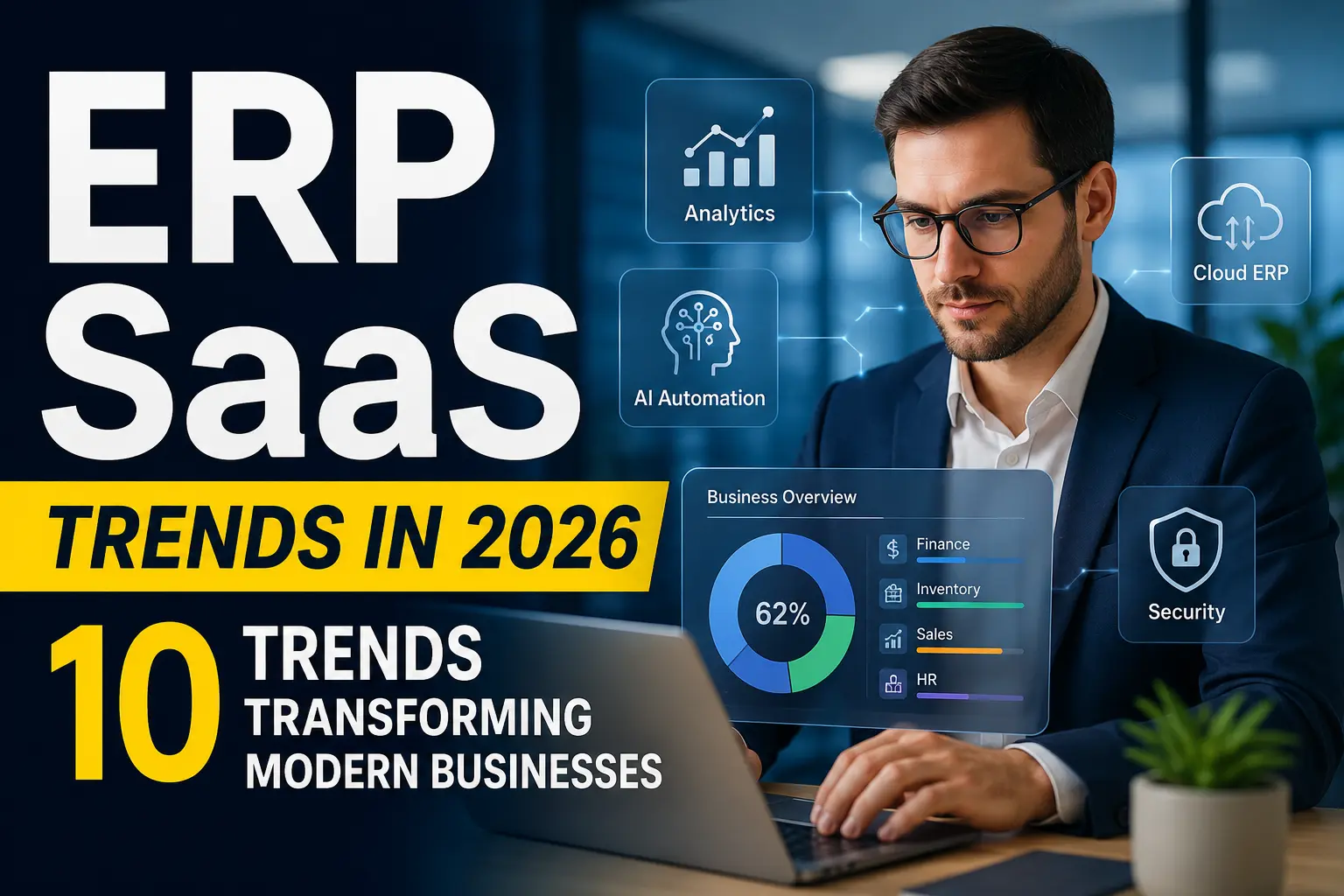
Top ERP SaaS Trends for 2026: The Future of Business Management
Running a business with spreadsheets, disconnected apps, and endless manual updates can feel like playing whack-a-mole. You fix one problem, and three more pop up. That’s exactly why ERP SaaS trends for 2026 matter so much: modern businesses want one connected system that can actually keep up.
ERP software has changed dramatically over the last few years. Cloud delivery, automation, artificial intelligence, real-time analytics, mobile access, and flexible integrations now shape the way companies manage finance, inventory, people, customers, and operations.
And 2026 looks even more interesting.
Instead of simply moving traditional ERP software into the cloud, vendors now focus on smarter automation, AI-powered decisions, industry-specific features, better user experiences, and real-time business intelligence.
So, what should business owners and IT teams watch this year? Let’s look at the biggest ERP SaaS trends for 2026 and what they could mean for your business.
What Is ERP SaaS?
Before we talk about the trends, let’s quickly clear up the terminology.
ERP SaaS stands for Enterprise Resource Planning Software as a Service. Instead of installing ERP software on your own servers, you access the platform through the internet.
A SaaS ERP platform typically brings multiple business functions into one environment, including:
- Accounting and financial management
- Inventory management
- Procurement
- Human resources
- Sales operations
- Customer management
- Supply chain management
- Project management
- Business reporting
- Manufacturing operations
The SaaS model also changes how companies manage their technology.
Instead of purchasing servers, installing software, handling complicated upgrades, and maintaining infrastructure, businesses usually pay a subscription and let the ERP provider handle much of the technical workload.
That sounds simple, right?
Well, mostly. Choosing the wrong ERP can still create a spectacular mess. Technology may have improved, but bad implementation decisions haven’t disappeared. 🙂
Why ERP SaaS Matters More in 2026
Businesses now generate huge amounts of operational data every day.
Sales teams create customer data. Finance teams generate transaction records. Warehouse teams track inventory. Marketing teams measure campaigns. Managers monitor performance.
Without a connected system, that information can end up scattered across dozens of applications.
ERP SaaS connects those business processes and gives teams a shared source of information.
That connection matters because companies increasingly want faster answers.
Managers don’t want to wait until the end of the month to discover a cash-flow problem. Warehouse teams don’t want to discover stock shortages after customers place orders. Finance teams don’t want employees to spend hours combining spreadsheets.
Modern ERP platforms aim to solve these problems through automation and real-time data.
That brings us to the biggest trends shaping ERP SaaS in 2026.
1. AI-Powered ERP Becomes the New Normal
Artificial intelligence has quickly moved from a marketing buzzword into a practical ERP feature.
In 2026, businesses increasingly expect ERP platforms to use AI for everyday tasks rather than simply displaying an impressive chatbot.
AI-powered ERP can analyze business data, identify patterns, automate repetitive work, and help employees make faster decisions.
For example, an ERP system can analyze purchasing history and identify unusual spending patterns. It can also help finance teams categorize transactions, identify anomalies, forecast cash flow, and summarize financial information.
AI Assistants Inside ERP Platforms
Many ERP platforms now experiment with conversational interfaces.
Instead of opening several reports, a manager could ask:
“Which products generated the highest profit last quarter?”
The system could analyze the relevant data and return an answer.
That approach could make ERP software much easier for nontechnical employees.
After all, nobody wakes up excited about navigating twelve reporting menus before breakfast.
AI Forecasting
AI can also improve forecasting.
Businesses can use historical sales, inventory, pricing, seasonality, and other operational data to create more useful forecasts.
Companies can apply these forecasts to:
- Demand planning
- Revenue forecasting
- Cash-flow planning
- Inventory purchasing
- Workforce planning
- Sales forecasting
- Budget management
The biggest opportunity doesn’t come from AI replacing employees. It comes from AI helping employees spend less time searching for information and more time acting on it.
2. ERP Automation Will Reduce Manual Work
Manual data entry creates two problems: it consumes time and creates opportunities for mistakes.
ERP SaaS platforms increasingly use automation to remove repetitive workflows.
For example, a company could create an automated workflow that:
- Receives a purchase request.
- Checks approval rules.
- Routes the request to the appropriate manager.
- Creates a purchase order after approval.
- Updates inventory records.
- Sends the required notifications.
- Records the transaction for accounting.
Nobody needs to copy information between five different systems.
Intelligent Workflow Automation
Modern ERP platforms go beyond basic “if this happens, do that” rules.
AI and machine learning can help systems identify patterns and recommend actions.
For example, an ERP platform could notice that a particular supplier frequently delivers late. The system could flag that supplier during future purchasing decisions.
Automation works best when it removes friction without removing human control.
Companies still need people to approve important financial decisions, review unusual transactions, and handle exceptions.
3. Real-Time Analytics Will Replace Waiting for Reports
Remember when managers had to ask someone to prepare a report before they could make a decision?
That approach feels increasingly outdated.
Real-time ERP analytics gives decision-makers access to current operational information without waiting for manual reporting.
A finance manager might monitor cash flow throughout the day. A warehouse manager might track inventory levels in real time. A sales leader could monitor orders, revenue, and margins from the same dashboard.
ERP Dashboards Become More Useful
Modern dashboards focus less on displaying every possible number and more on highlighting what actually matters.
A good dashboard might show:
- Revenue
- Gross margin
- Cash position
- Outstanding invoices
- Inventory levels
- Sales pipeline
- Operating costs
- Customer activity
The best platforms also allow users to drill into the underlying data.
That distinction matters.
A dashboard should help you answer “Why did this happen?”, not simply tell you that something happened.
4. Composable ERP Will Challenge Traditional ERP Suites
Here’s an interesting shift: businesses increasingly want ERP platforms that can adapt to them.
Traditional ERP implementations often follow a large, predefined structure. Companies may need to change their workflows to fit the software.
Composable ERP takes a more flexible approach.
Businesses can combine different applications, services, and modules to create a technology stack that fits their specific requirements.
For example, a company might use:
- One platform for finance
- Another application for customer support
- A specialized manufacturing system
- A separate payroll platform
- An ecommerce platform
- An analytics service
APIs and integrations can connect these systems.
Why Composable ERP Matters
Different companies have different priorities.
A manufacturer may care deeply about production planning. A software company may focus more heavily on project management and revenue recognition. A retailer may prioritize inventory and ecommerce integration.
Why force every company into exactly the same technology setup?
Composable ERP gives businesses more control over how they build their technology environment.
5. Industry-Specific ERP SaaS Will Grow
Generic ERP software can work well for many companies, but specialized industries often need specialized workflows.
That’s why vertical ERP solutions continue to gain attention.
ERP vendors increasingly develop platforms for industries such as:
- Manufacturing
- Healthcare
- Construction
- Retail
- Professional services
- Distribution
- Logistics
- Hospitality
- Financial services
A construction company, for example, may need project costing, subcontractor management, procurement, scheduling, and job profitability tools.
A retailer may care more about inventory, purchasing, ecommerce, promotions, and customer transactions.
Industry Features Can Speed Up Implementation
Industry-specific ERP can reduce the amount of customization a company needs.
That can help businesses implement systems faster and reduce unnecessary development costs.
IMO, this trend makes a lot of sense.
Companies shouldn’t need to spend months rebuilding basic industry workflows that specialized ERP vendors already understand.
6. ERP and Business Intelligence Will Become More Connected
ERP systems contain valuable information, but raw data doesn’t automatically create useful insight.
That’s where business intelligence enters the picture.
ERP platforms increasingly combine operational data with advanced analytics and business intelligence tools.
This combination helps companies understand not only what happened but also why it happened and what could happen next.
Descriptive, Predictive, and Prescriptive Analytics
Businesses can think about analytics in three levels:
Descriptive analytics answers:
What happened?
Predictive analytics answers:
What might happen next?
Prescriptive analytics asks:
What should we do about it?
For example, an ERP system might show that inventory costs increased.
Predictive analytics could estimate future inventory costs.
Prescriptive analytics could recommend different purchasing quantities or suppliers.
That progression makes ERP much more useful for strategic planning.
7. Mobile ERP Will Become Even More Important
Employees no longer spend every working hour sitting at a desk.
Managers travel. Salespeople visit customers. Warehouse employees work on the floor. Field service teams work at customer locations.
That reality makes mobile ERP access increasingly important.
Modern ERP SaaS platforms can give employees access through smartphones and tablets.
Mobile users can potentially:
- Approve expenses
- Review invoices
- Check inventory
- Approve purchases
- Monitor sales
- Submit expenses
- Review dashboards
- Update customer information
- Track field activities
Mobile UX Matters
A desktop ERP interface squeezed onto a phone screen doesn’t count as a great mobile experience.
Users need interfaces designed around mobile workflows.
Companies should evaluate mobile applications carefully when selecting ERP software.
Ask yourself: Would an employee actually want to use this app every day?
That question can reveal more than a glossy product demo.
8. Cybersecurity Will Become a Bigger ERP Priority
More businesses rely on cloud ERP platforms, which makes cybersecurity increasingly important.
ERP systems often contain extremely valuable information, including financial records, employee data, customer information, supplier details, and business operations.
A security problem could create serious financial and operational consequences.
What Should Businesses Look For?
When evaluating an ERP SaaS provider, companies should examine:
- Data encryption
- Multi-factor authentication
- Role-based access
- Audit logs
- Security monitoring
- Backup policies
- Incident response procedures
- Compliance capabilities
- Identity and access management
Security shouldn’t become an afterthought.
Companies should evaluate security before signing an ERP contract, not after a problem appears.
Zero-Trust Security
Zero-trust approaches will also receive more attention.
Instead of automatically trusting users or devices inside a network, zero-trust security continuously evaluates access.
That approach fits cloud environments particularly well because employees can access systems from different devices and locations.
9. ERP Integration Will Matter More Than Ever
No ERP platform exists in isolation.
Businesses already use dozens of specialized tools.
Common integrations include:
- CRM platforms
- Ecommerce systems
- Payment processors
- Banking platforms
- Payroll systems
- Marketing tools
- Customer support platforms
- Shipping software
- Warehouse systems
- Business intelligence platforms
Strong APIs and integration capabilities can make or break an ERP implementation.
A powerful ERP that cannot connect smoothly with your existing technology can quickly become a headache.
API-First ERP
API-first architecture allows applications to communicate more easily.
Developers can connect systems without rebuilding everything from scratch.
This flexibility supports the broader composable ERP trend.
FYI, integration quality deserves the same attention as features such as accounting, inventory, and reporting.
A shiny feature list means little if your systems cannot communicate properly.
10. Low-Code and No-Code ERP Customization Will Expand
Businesses often need custom workflows.
Traditionally, developers handled most ERP customization.
That approach can work, but it can also create delays and additional costs.
Low-code and no-code tools allow business users to customize workflows with less traditional programming.
Users might create:
- Approval workflows
- Custom forms
- Automated notifications
- Business rules
- Simple dashboards
- Data-entry processes
Why This Matters
Imagine a finance manager who wants every purchase above a certain amount to require two approvals.
Instead of waiting for developers to build the workflow, the manager could configure the rule using a visual interface.
That can shorten development cycles.
However, businesses still need governance.
Giving everyone unlimited customization power sounds fun until the ERP turns into a digital jungle nobody understands. :/
11. ERP SaaS Will Support Better Financial Planning
Finance teams increasingly want ERP platforms that support more than basic accounting.
They want tools that help them understand future performance.
That means ERP platforms will continue expanding capabilities around:
- Financial planning
- Budgeting
- Forecasting
- Scenario analysis
- Cash-flow management
- Revenue recognition
- Expense management
- Financial consolidation
Scenario Planning
Scenario planning can help businesses prepare for uncertainty.
For example, finance teams could model:
Scenario A: Sales increase by 15%.
Scenario B: Sales remain flat.
Scenario C: Sales decrease by 10%.
The company can then compare potential cash-flow, staffing, inventory, and profitability outcomes.
ERP becomes more valuable when it helps companies prepare for tomorrow instead of simply recording yesterday.
12. Sustainability Data Will Enter ERP Workflows
Sustainability has become a business concern, not just a marketing topic.
Companies increasingly need better visibility into resource usage, supply chains, emissions, waste, and operational efficiency.
ERP platforms can help businesses collect and organize this information.
Potential areas include:
- Energy consumption
- Supply-chain data
- Waste tracking
- Transportation activity
- Resource usage
- Supplier information
- Sustainability reporting
ERP systems can connect operational activity with sustainability metrics.
For example, procurement teams could compare suppliers using both cost and sustainability criteria.
Better data can help companies make sustainability decisions based on evidence rather than vague promises.
13. ERP Will Become More User-Friendly
ERP software has a reputation for complicated interfaces.
And honestly, some of that reputation comes from experience.
Nobody wants to click through six menus just to approve a simple expense.
ERP vendors increasingly focus on consumer-style user experiences.
That means cleaner dashboards, simpler navigation, personalized interfaces, search functionality, and conversational interactions.
Personalization
Different employees need different information.
A CFO might want financial dashboards.
A warehouse manager might want inventory alerts.
A sales manager might want revenue and pipeline information.
Modern ERP platforms can personalize the experience around each user’s role.
That can improve adoption because employees see information that actually matters to them.
14. Cloud ERP Will Continue Replacing Legacy Systems
Cloud ERP adoption will continue because businesses increasingly value flexibility and scalability.
Legacy ERP systems often require companies to manage infrastructure, upgrades, and maintenance themselves.
Cloud ERP can reduce much of that burden.
Businesses can also scale cloud resources as their requirements change.
Cloud ERP Benefits
Companies often choose SaaS ERP because it can provide:
- Lower upfront infrastructure costs
- Faster deployment
- Automatic software updates
- Remote accessibility
- Simpler scalability
- Easier integration
- Centralized data
- Predictable subscription pricing
However, companies should look beyond the monthly subscription.
Implementation costs, customization, integrations, training, data migration, and support can significantly affect the total cost of ownership.
15. ERP Data Quality Will Become a Strategic Priority
Here’s a trend that doesn’t receive enough attention: AI needs good data.
You can buy the smartest ERP platform available, but messy data can still produce messy results.
Duplicate customers, outdated inventory records, incorrect supplier information, inconsistent product names, and incomplete financial data can damage reporting and automation.
Data Governance Matters
Businesses should establish clear rules around:
- Data ownership
- Data quality
- Access permissions
- Duplicate records
- Data retention
- Standardized naming
- Reporting definitions
Before implementing advanced AI features, companies should clean their data.
Otherwise, you might get an extremely intelligent system confidently analyzing extremely questionable information. Not exactly the dream scenario.
ERP SaaS Trends 2026: What Should Businesses Prioritize?
You don’t need every shiny feature.
A small business doesn’t necessarily need the same ERP architecture as a global manufacturer.
Instead, focus on your actual business problems.
Here are some practical priorities.
For Small Businesses
Focus on:
- Easy implementation
- Affordable pricing
- Accounting
- Invoicing
- Inventory
- Basic automation
- Mobile access
- Simple reporting
- Essential integrations
For Growing Businesses
Prioritize:
- Scalability
- Workflow automation
- CRM integration
- Advanced reporting
- Financial planning
- Inventory management
- API capabilities
- Role-based permissions
For Large Enterprises
Look closely at:
- AI capabilities
- Global financial management
- Advanced analytics
- Security
- Compliance
- Multi-entity support
- Supply-chain management
- Integration architecture
- Customization
- Data governance
How to Choose the Right ERP SaaS Platform in 2026
Choosing ERP software can feel overwhelming.
Every vendor has impressive demos. Every sales presentation promises transformation.
So how do you separate useful features from marketing fireworks?
Start with your business requirements.
Step 1: Identify Your Biggest Problems
Ask:
- Where do employees waste the most time?
- Which processes rely heavily on spreadsheets?
- Where do data errors occur?
- Which systems fail to communicate?
- Which reports take too long to produce?
- Where do customers experience delays?
Your answers should guide your ERP requirements.
Step 2: Map Your Workflows
Document your important processes.
For example:
Order → Inventory → Shipping → Invoice → Payment → Accounting
Then identify where employees manually enter or transfer information.
Those bottlenecks can reveal your biggest ERP opportunities.
Step 3: Evaluate Integration Capabilities
Never assume that two systems will integrate smoothly.
Ask vendors about:
- APIs
- Connectors
- Webhooks
- Data migration
- Integration costs
- Third-party applications
A strong integration strategy can save significant time later.
Step 4: Test Usability
Give real employees access to a trial or demonstration environment.
Ask them to complete common tasks.
Can they create an invoice?
Can they find a customer?
Can they approve a purchase?
Can they generate a report?
If employees struggle during the demo, don’t assume training will magically fix everything.
Step 5: Calculate Total Cost
Look beyond subscription pricing.
Calculate:
Software + Implementation + Migration + Customization + Integrations + Training + Support
That number gives you a much clearer picture.
ERP SaaS vs Traditional ERP
The difference between SaaS ERP and traditional ERP goes beyond hosting.
| Feature | ERP SaaS | Traditional ERP |
|---|---|---|
| Deployment | Cloud-based | Often on-premises |
| Infrastructure | Vendor-managed | Customer-managed |
| Updates | Frequent vendor updates | Customer-controlled |
| Accessibility | Internet-based | Often network-dependent |
| Scalability | Generally flexible | May require infrastructure changes |
| Upfront hardware | Usually lower | Often higher |
| Customization | Configurable and integrated | Often highly customized |
| Maintenance | Mostly vendor-managed | Mostly customer-managed |
Neither model automatically wins every situation.
Companies with strict infrastructure requirements or unusual operational needs may still prefer greater control.
However, ERP SaaS gives many businesses a simpler path toward modernization.
The Biggest ERP SaaS Challenge in 2026
Technology isn’t usually the hardest part.
People are.
Employees may resist new software. Managers may protect old processes. Departments may disagree about data definitions. Leadership may underestimate training requirements.
That’s why change management remains critical.
Companies should communicate why they selected the ERP, involve employees early, provide training, and measure adoption.
A technically excellent ERP can still fail if employees refuse to use it.
The Future of ERP SaaS: What Comes Next?
The next generation of ERP software will likely feel less like traditional business software and more like an intelligent business operating system.
Think about the progression:
ERP records information → ERP connects information → ERP analyzes information → ERP recommends actions → ERP automates selected actions.
That progression could fundamentally change how companies manage operations.
Instead of spending hours searching through reports, employees could ask questions directly.
Instead of manually checking every transaction, finance teams could focus on exceptions.
Instead of reacting to inventory shortages, companies could receive earlier warnings.
Instead of building reports manually, managers could interact with live business data.
The real future of ERP SaaS involves turning business data into useful action.
Final Thoughts: Are You Ready for the Next Generation of ERP?
The biggest ERP SaaS trends for 2026 revolve around one simple idea: businesses want technology that works harder without making work harder.
AI will make ERP systems smarter.
Automation will reduce repetitive tasks.
Real-time analytics will improve decision-making.
Composable architecture will increase flexibility.
Industry-specific platforms will deliver more relevant workflows.
Mobile ERP will support distributed teams.
Security and data governance will become even more important.
And low-code tools will give businesses more control over customization.
But don’t chase every trend simply because a vendor puts “AI-powered” on a presentation slide.
Choose technology based on the problems your business actually needs to solve.
A great ERP system should help employees work faster, give managers better information, reduce unnecessary manual work, and create a stronger foundation for growth.
The best ERP SaaS platform for 2026 isn’t necessarily the one with the longest feature list. It’s the one that fits your business, connects your data, supports your people, and helps you make better decisions.
So, take a look at your current systems.
Where do your teams still copy and paste data?
Which reports take forever?
Which processes make employees sigh before they even start?
Those pain points might tell you more about your ERP future than any technology trend ever could.
Read More: How ERP SaaS Boosts Business Productivity: 10 Powerful Benefits
My new site: news9.live